
The Ultimate NAPLEX Study Schedule: 2026 Strategy and Templates
What if the 1,200 pages of clinical material you’re currently trying to memorize are actually your biggest obstacle to passing? Most pharmacy graduates feel buried under a mountain of data while trying to master complex pharmaceutical calculations during a 40-hour residency week. It’s a recipe for burnout that causes many to freeze when they finally face the 250-question exam. You likely agree that the hardest part isn’t the science itself; it’s finding a naplex study schedule that fits into a life already filled with professional responsibilities.
This guide provides a structured, high-yield strategy designed to ensure you pass on your first attempt in 2026 without sacrificing your mental health. You’ve worked too hard to let a lack of structure stop you now. We’ve distilled the most critical competencies into a manageable daily checklist that prioritizes long-term retention over rote memorization. You’ll gain access to customizable templates that highlight the top 20% of topics responsible for 80% of the exam points. This approach builds the confidence you need to tackle everything from oncology to pharmacokinetics with clinical precision.
Key Takeaways
- Learn how to move beyond generic calendars by building a personalized timeline that weights pharmacy topics based on your specific strengths and weaknesses.
- Identify the “Heavy Hitters” of the exam and discover why mastering calculations and biostatistics is the non-negotiable foundation of a successful naplex study schedule.
- Compare 4, 8, and 12-week templates to select the preparation pace that matches your clinical baseline and professional commitments.
- Optimize your daily routine with a structured “Math Hour” and clinical deep dives designed to maximize retention while preventing study burnout.
- Explore how micro-learning segments and expert-led video vignettes can streamline your 2026 boards preparation through high-yield, digital-first strategies.
The Foundation of a Passing NAPLEX Study Schedule
Success on the board exam depends on more than just memorizing drug classes. A robust naplex study schedule acts as a tactical roadmap, typically spanning 4 to 12 weeks, designed to cover the six competency areas defined by the NABP. Generic calendars often fail because they treat every student’s knowledge base as identical. If you excelled in your infectious disease rotations but struggled with pharmacokinetics, a one-size-fits-all plan wastes your most valuable resource: time. You must weigh topics based on your personal performance metrics. For the 2026 cycle, candidates should expect a heavy emphasis on clinical decision-making and precise pharmaceutical calculations. These areas remain the bedrock of the NAPLEX – Wikipedia assessment framework and require consistent, daily practice rather than sporadic review sessions.
The Diagnostic Phase: Testing Before Studying
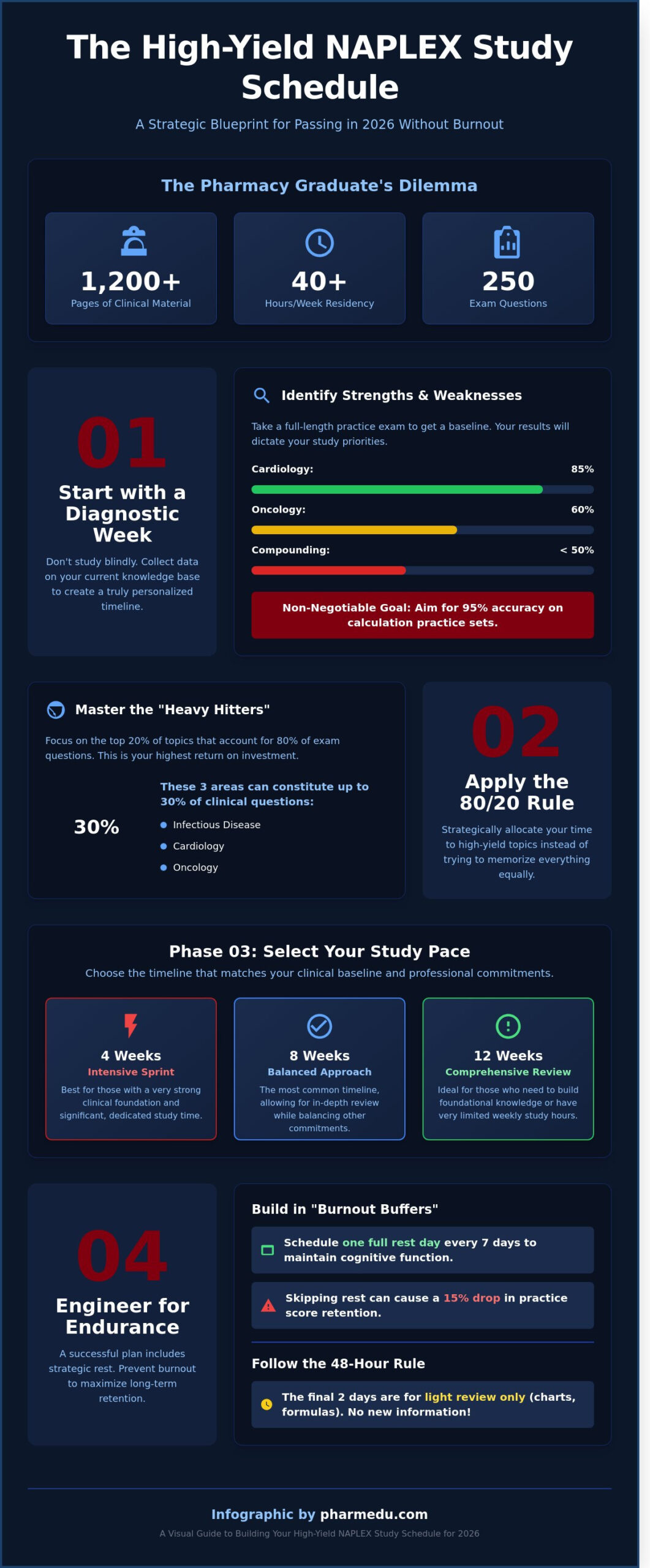
Start your preparation with a “Diagnostic Week.” This isn’t for studying; it’s for data collection. Take a full-length, 250-question practice exam under timed conditions to establish a baseline. You’ll likely find that while your cardiology knowledge is at 85%, your oncology or compounding accuracy sits below 60%. Use these specific percentages to front-load your most difficult subjects. Research shows that tackling high-complexity topics early prevents the “panic-cramming” that occurs in the final 14 days of a timeline. Pay special attention to calculation speed and accuracy. You should aim for a 95% accuracy rate on practice sets before moving past the foundation phase of your naplex study schedule.
Setting Your 2026 Test Date Strategy
Timing your exam is a logistical puzzle that requires precision. Most graduates receive their Authorization to Test (ATT) within 15 to 30 days of graduation, depending on state board processing speeds. Don’t wait for the email to arrive before you begin. Align your study window so it culminates exactly when you expect to sit for the boards. It’s vital to build in “burnout buffers.”
- Weekly Rest: Schedule one full day of rest every 7 days to maintain cognitive function.
- Retention Data: Candidates who skip rest days often see a 15% drop in practice score retention by week six.
- The 48-Hour Rule: Reserve the final 2 days for light review of high-level charts and formulas.
Cramming new information 48 hours before the exam rarely sticks. It only increases cortisol levels, which can impair your ability to recall information during the actual 6-hour testing window. Your goal is to arrive at the testing center mentally fresh and prepared to apply clinical logic to complex patient cases.
Prioritizing High-Yield Topics: The 80/20 Rule of Pharmacy Boards
Success on the board exam isn’t about memorizing every page of a 1,000-page review book. It’s about strategic allocation. The 80/20 rule suggests that 80% of your passing score will come from mastering 20% of the core material. Your naplex study schedule should reflect this reality by front-loading “Heavy Hitters” like Infectious Disease, Cardiology, and Oncology. These three areas alone can constitute up to 30% of the clinical questions you’ll face. While niche specialty medications for rare genetic conditions are interesting, they don’t offer the same return on investment as the Top 200 drugs.
According to the Official NAPLEX Information, the exam evaluates your ability to identify drug characteristics and develop treatment plans across six competency areas. This means you can’t ignore the overlap between the NAPLEX and the MPJE. Topics like sterile and non-sterile compounding (USP 797 and 795) and federal law requirements are frequently tested in both exams. Dedicating specific blocks to these foundational topics early in your naplex study schedule ensures you aren’t scrambling to learn regulations during the final week of review.
Clinical Domain Mastery
Focus your energy on major organ systems including Renal, Hepatic, and the Central Nervous System. Instead of rote memorization, use high-yield video vignettes to visualize how a drug like a loop diuretic actually interacts with the ascending limb of the loop of Henle. You must prioritize “Must-Know” side effects and boxed warnings for each drug class. For instance, knowing the specific monitoring requirements for clozapine or the black box warnings for ACE inhibitors is non-negotiable. If you’re feeling overwhelmed by the volume of information, you can access our structured learning paths to simplify these complex mechanisms.
Calculations: The Daily Non-Negotiable
Pharmaceutical math is the foundation of a passing score; it’s often the difference between a 74 and a 75. You must practice calculations every single day for at least 30 to 45 minutes, regardless of whether you’re studying HIV or Hypertension. Mastery isn’t just about knowing the formula; it’s about speed and precision under pressure. You’ll need to handle alligations, milliequivalents, and pharmacokinetics (PK) with 100% accuracy. Using interactive pharmacology quizzes is an excellent way to build the muscle memory required to solve complex dosing problems without second-guessing your work.
Choosing Your Timeline: 4, 8, and 12-Week Study Templates
Every candidate’s path to licensure is unique. Selecting the right naplex study schedule depends on your baseline competency and your current professional commitments. You can’t apply a one-size-fits-all approach when the stakes involve a 225-question high-stakes examination. Your timeline should reflect your recent academic performance and the hours you can realistically dedicate each day.
- The 4-Week “Sprint”: This intensive path is best for pharmacy residents or students who ranked in the top 15% of their graduating class. It requires a full-time commitment of 50 to 60 hours per week. You’ll need to cover roughly three to four clinical chapters every day to stay on track.
- The 8-Week “Standard”: This is the recommended sweet spot for the majority of graduates. It allows for a manageable 25-hour weekly commitment. This pace promotes long-term retention and prevents the cognitive fatigue that often leads to simple calculation errors on exam day.
- The 12-Week “Deep Dive”: If you’re working 40 hours a week or if you’ve been out of school for more than 12 months, this is your best option. It provides the necessary cushion to revisit foundational pathophysiology without rushing through complex topics like oncology or immunology.
Data from previous test cycles suggests that students who score below a scaled 70 on practice exams should immediately pivot. If your scores aren’t improving after three weeks of consistent effort, don’t ignore the warning signs. Extend your naplex study schedule by at least 14 days. Use this extra time to focus exclusively on your lowest-performing competency areas rather than re-reading chapters you’ve already mastered.
The 8-Week Standard Template
The standard template balances high-yield calculations with complex clinical management. Structure your first two weeks around pharmaceutical calculations, biostatistics, and the top 200 drug classes. These areas are the “low-hanging fruit” that provide a safety net for your score. During weeks three through five, move into major clinical systems including Infectious Diseases, Cardiology, Diabetes, and Pulmonary disorders. Spend the final three weeks on minor systems, federal law basics, and compounding. Always schedule at least two full-length exam simulations during the final seven days to build your testing endurance.
Adjusting for Life Events and Work
Life doesn’t stop because you’re studying for boards. Consistency beats intensity every time. Use “Micro-Learning” blocks to turn 15-minute gaps during commutes or lunch breaks into productive review sessions for drug brand/generic names or lab values. Save your weekend “Power Sessions” for the heavy lifting, such as mastering HIV regimens or oncology protocols. It’s vital to use a naplex prep course that offers mobile-compliant content. Having access to high-quality question banks on your phone ensures you don’t fall behind when you’re away from your desk.
The Anatomy of a Perfect Study Day: A Daily Routine Template
Consistency is the foundation of success when preparing for the 2026 boards. A high-performance naplex study schedule isn’t about the quantity of hours spent at a desk; it’s about aligning your most difficult tasks with your peak cognitive windows. Dividing your day into four distinct blocks ensures that you maintain focus without succumbing to mental fatigue.
- 08:00 – 09:30: The Math Hour. Calculations account for approximately 11 percent of the total exam items. Tackle these first when your brain is sharpest. Focus on TPN, mEq, and alligations to build the muscle memory required for the exam’s “fill-in-the-blank” questions.
- 10:30 – 13:30: Clinical Deep Dive. Dedicate this block to one major therapeutic chapter, such as Cardiology or Infectious Disease. This is your time for deep concentration on guidelines and drug of choice (DOC) selections.
- 14:30 – 16:30: Active Recall Session. Transition away from your textbook. Use this window to test your knowledge of the morning’s material using flashcards or practice questions.
- 19:30 – 20:30: Review and Prep. Wind down by watching high-yield video vignettes for the next day’s topic. This primes your brain for the upcoming material, making the next morning’s deep dive more efficient.
Active Recall vs. Passive Reading
Rereading a textbook is the least effective way to prepare for the NAPLEX. Research indicates that students who engage in active recall retain 50 percent more information after one week than those who simply highlight text. Use “Spaced Repetition” for complex drug-drug interactions by reviewing difficult cards at increasing intervals. If you can’t explain a clinical concept out loud using the “Teach-Back” method, you haven’t mastered it yet. Explaining the mechanism of action for SGLT2 inhibitors to an imaginary patient forces your brain to organize the data logically.
Utilizing High-Yield Video Vignettes
Complex pharmacology in areas like Oncology or HIV can feel overwhelming when viewed as 80-page chapters. Break these down into 5-10 minute visual segments to improve retention. Visual learning helps you map out protease inhibitor side effects or chemotherapy toxicities more effectively than text alone. Track your progress through micro-learning milestones. Completing three short videos on antiretroviral therapy feels more achievable than finishing a whole chapter, which keeps your motivation high throughout your naplex study schedule.
Ready to transform your preparation into a structured path toward licensure? Explore our professional development resources and optimize your pharmacy career path with PharmEdu today.
Optimizing Your Prep with PharmEDU’s Digital Platform
Successfully executing a naplex study schedule requires more than just a calendar; it requires tools that adapt to your daily workflow. PharmEDU provides micro-learning segments designed for the 2026 candidate who balances clinical rotations with intensive review. These bite-sized modules allow you to master complex pharmacology without feeling overwhelmed by 1,000-page manuals. You’ll find over 100 high-yield topics condensed into expert-led video vignettes. These aren’t long, rambling lectures. They’re precision-engineered segments that target specific NAPLEX competencies with surgical accuracy.
By using interactive flashcards and randomized quizzes, you automate your active recall sessions. Cognitive science indicates that active retrieval increases long-term retention rates by up to 50% compared to passive reading. The platform’s mobile-compliant design means you can turn a 15-minute commute or a lunch break into a high-impact study session. It’s about maximizing every available pocket of time in your busy 2026 schedule.
- Expert-Led Vignettes: Focus on the 100+ most tested therapeutic areas.
- Automated Active Recall: Use digital flashcards to solidify drug-class interactions.
- Anywhere Access: Study on your phone, tablet, or desktop with seamless syncing.
Why a Digital Mentor Beats a Physical Textbook
Textbooks often become obsolete the moment they’re printed. For the 2026 exam cycle, staying current with shifting clinical guidelines, such as the latest GINA updates or new cardiovascular protocols, is non-negotiable. PharmEDU updates its content in real-time to reflect these changes. You can track your performance metrics through a personalized dashboard, seeing exactly where your naplex study schedule needs adjustment. Our case studies mirror the multi-step complexity of the actual exam, ensuring you’re prepared for the 225 questions you’ll face on test day.
Getting Started with Your Custom Plan
You can bridge the gap between theory and practice by integrating our clinical vignettes into your 8-week template. Spend your mornings on core concepts and your evenings on PharmEDU’s interactive modules to test your knowledge. This dual-layered approach solidifies your knowledge base and builds the stamina needed for the six-hour exam. Subscribing provides instant access to the full pharmacology library, allowing you to move at your own pace while staying on track for your target test date.
Secure Your Pharmacy License with a Precise 2026 Strategy
Passing the boards in 2026 requires more than just broad reading. You’ve got to master the 80/20 rule by focusing on the most frequent clinical scenarios and complex calculations. Whether you commit to a 4, 8, or 12-week timeline, your naplex study schedule needs to prioritize active recall and structured daily routines to ensure long-term retention. Consistency is the primary factor that separates successful candidates from those who struggle on exam day.
Success depends on using specialized tools that fit into a demanding professional life. PharmEDU provides the technical precision you need with over 100 high-yield pharmacology topics and interactive case studies designed for modern pharmacy graduates. Our mobile-compliant micro-learning modules allow you to study during small windows of time, while interactive flashcards reinforce the critical data points required for a passing score. You don’t have to navigate this high-stakes preparation alone.
Master the NAPLEX with PharmEDU High-Yield Reviews
You’ve dedicated years to your education and worked hard for your degree. Now it’s time to validate that effort. With the right plan and professional resources, you’ll step into the testing center with total confidence in your clinical knowledge.
Frequently Asked Questions
How long should I study for the NAPLEX in 2026?
You should plan for a study period of 8 to 12 weeks to ensure comprehensive coverage of all competency statements. Most successful candidates log between 300 and 400 total study hours before their exam date. If you’re balancing a full-time residency or job, extending this period to 16 weeks provides a necessary buffer for unexpected delays.
Is 4 weeks enough time to study for the NAPLEX?
Four weeks is sufficient only for candidates who can commit to 10 hours of daily, high-intensity review without other obligations. This condensed naplex study schedule leaves zero margin for error or personal emergencies. Data suggests that students who study for less than 6 weeks have a 15% lower pass rate than those who prepare for 10 weeks or more.
What are the most important topics to focus on for the NAPLEX?
Calculations, infectious diseases, and cardiovascular disorders are the most critical domains to master for the 2026 exam. Calculations alone represent about 14% of the total exam score. Prioritize these areas because they appear frequently and require deep analytical thinking rather than simple rote memorization.
How many hours a day should I study for the pharmacy boards?
You should study for 4 to 6 hours daily to maintain peak cognitive performance and avoid burnout. Research indicates that retention rates drop by 25% after the sixth hour of continuous mental exertion. It’s better to have five highly productive hours than ten hours of distracted reading or passive video watching.
What study materials are best for the NAPLEX in 2026?
The most effective materials for 2026 are the RxPrep Course Book and the Pass NAPLEX Now (PNN) lectures. Approximately 90% of accredited pharmacy programs recommend these resources for their high alignment with current NABP blueprints. Always include the official Pre-NAPLEX practice exam in your budget to test your stamina under real conditions.
How do I handle calculation anxiety during the exam?
You can manage calculation anxiety by completing a minimum of 20 practice problems every day for 6 weeks. Repetition builds the muscle memory needed to solve complex dosing questions in under two minutes. Familiarizing yourself with the on-screen calculator during practice sessions also prevents technical panic on the actual test day.
Should I study for the MPJE and NAPLEX at the same time?
You should avoid studying for both exams simultaneously to prevent cognitive overload and confusion. Focus entirely on the NAPLEX first, then pivot to the MPJE for a dedicated 14 day law intensive. This sequence ensures you don’t mix up clinical guidelines with specific state pharmacy statutes during your naplex study schedule.
What should I do if I am failing my NAPLEX practice exams?
Postpone your test date immediately if your practice scores fall below the 75 point threshold. Use the diagnostic feedback to adjust your study plan, focusing specifically on your bottom three performing categories. Spending an extra 21 days on targeted review is a better professional strategy than failing and waiting the mandatory 45 days to retake the exam.