The Best NAPLEX Prep Course Guide: How to Pass in 2026
In 2023, the NABP reported that the first-time pass rate for the NAPLEX dipped to 77.5%, leaving nearly one in four graduates facing the crushing stress of a retake. This statistic proves that traditional, high-volume cramming isn’t just exhausting; it’s often mathematically ineffective. Selecting the right naplex prep course is no longer about finding the most pages of text. It’s about identifying a system that integrates with your 40-hour clinical rotation schedule without causing total burnout.
You’ve likely felt the weight of information overload while trying to memorize thousands of drug monographs between patient rounds. It’s frustrating to invest over $1,000 in study materials only to feel more anxious about high-yield pharmacology than when you began. We’re here to change that trajectory. This guide will show you how to master the most critical clinical content and pass the NAPLEX in 2026 on your first attempt. We’ll examine the most efficient prep programs based on their logical structure, evidence-based methodology, and ability to build the professional confidence you need for your first day as a licensed pharmacist.
Key Takeaways
- Master the 2026 NAPLEX adaptive exam structure by focusing on the core NABP competency areas that prioritize safe and effective pharmacotherapy.
- Transition from brute-force memorization to high-yield micro-learning strategies that align with your cognitive load for better long-term retention.
- Identify the essential features of a modern naplex prep course to ensure your study materials are fully aligned with the latest candidate application bulletins.
- Build a realistic, two-phase study schedule that allows you to balance intensive pharmacology reviews with your clinical rotation responsibilities.
- Explore how a subscription-based learning platform provides the professional guidance and flexibility needed to achieve board success without unnecessary burnout.
Understanding the 2026 NAPLEX Content Outline and Passing Standards
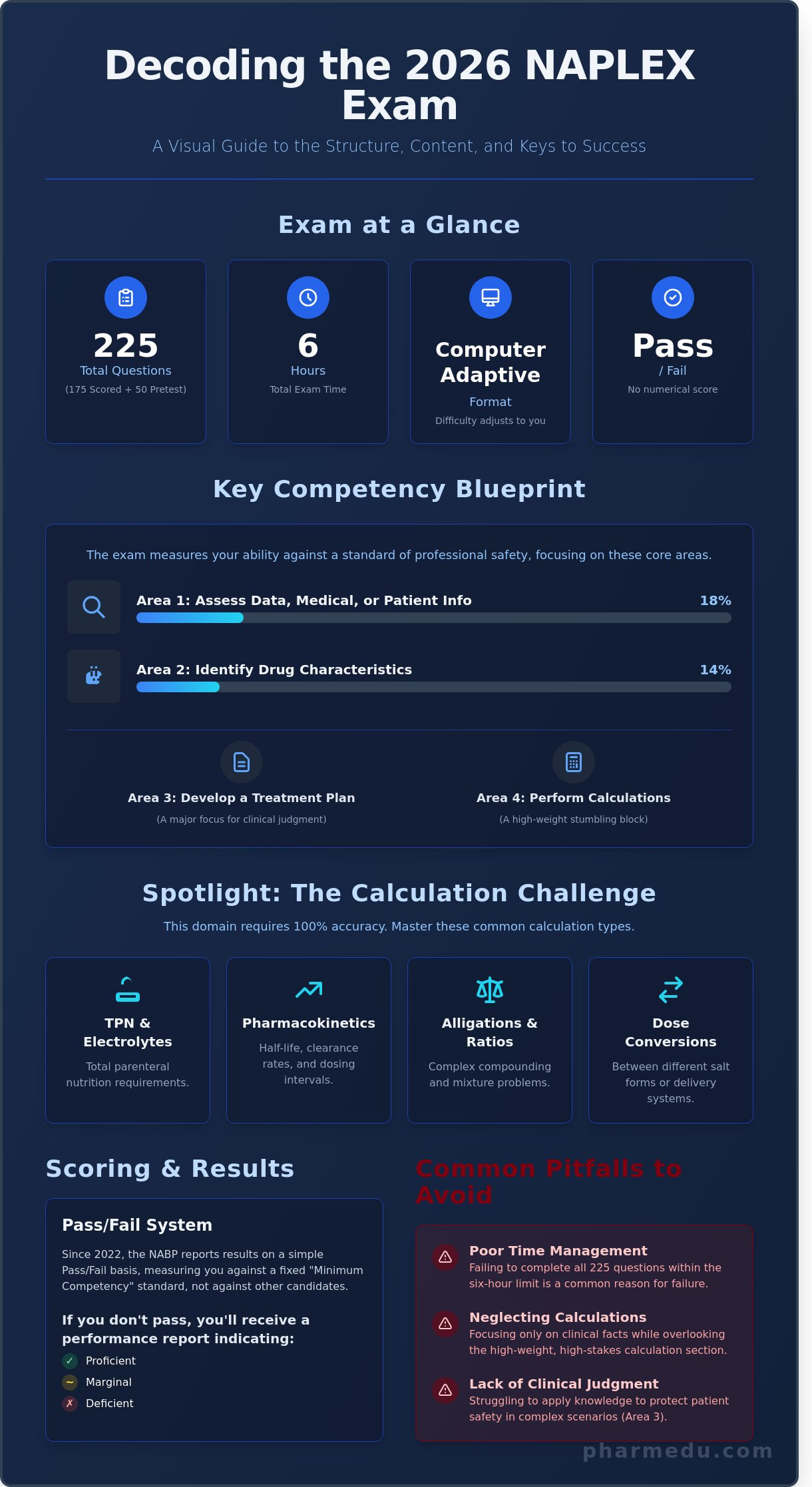
The 2026 NAPLEX remains a rigorous 225-question adaptive examination designed to ensure every licensed pharmacist can provide safe and effective pharmacotherapy. It’s a high-stakes assessment where the computer selects your next question based on your previous answer’s accuracy. This adaptive nature means the exam constantly recalibrates to find your true ability level. You’ll have six hours to complete the test, which includes 175 scored items and 50 pretest questions that don’t affect your final result. Success requires more than just memorizing drug classes; it demands the ability to synthesize complex patient data under pressure. For many Cincinnati graduates, choosing a high-quality naplex prep course is the most reliable way to bridge the gap between classroom theory and these stringent board expectations.
The National Association of Boards of Pharmacy (NABP) updated its standards to prioritize clinical judgment over rote memorization. This shift reflects the evolving role of pharmacists as primary healthcare providers who must make critical decisions in real time. For a deeper look at the exam’s evolution and its role in professional licensing, the NAPLEX Wikipedia page provides a comprehensive historical overview of the test’s structure and its importance across various jurisdictions. In 2026, the focus is squarely on your ability to identify potential medication errors and optimize therapeutic outcomes for diverse patient populations.
Key Competency Areas You Must Master
The current blueprint divides the exam into several critical domains. Area 1, which involves obtaining, interpreting, or assessing data, medical, or patient information, typically accounts for 18% of the scored questions. You’ll need to demonstrate precision when evaluating lab results and diagnostic findings. Area 2 focuses on identifying drug characteristics, representing approximately 14% of the exam. This section tests your knowledge of dosage forms, stability, and storage requirements. The NAPLEX is a competency-based assessment of pharmacy practice readiness. Beyond these areas, you must master Area 4, which covers pharmaceutical calculations. This domain remains a common stumbling block, requiring 100% accuracy in calculations involving:
- Total parenteral nutrition (TPN) and electrolyte requirements.
- Pharmacokinetics, including half-life and clearance rates.
- Alligations and complex compounding ratios.
- Dose conversions between different salt forms or delivery systems.
While federal pharmacy law is primarily the focus of the MPJE, the NAPLEX incorporates foundational legal concepts. You’ll encounter questions regarding the Controlled Substances Act and prescription requirements that intersect with patient safety. Your naplex prep course should emphasize these intersections to ensure you aren’t caught off guard by questions that blend clinical knowledge with regulatory standards.
Scoring and Results: What it Takes to Pass
Since January 2022, the NABP has reported NAPLEX results solely on a Pass/Fail basis. This change moved away from the traditional scaled score of 75, though the underlying “Minimum Competency” threshold remains just as demanding. The board evaluates your performance across all content domains using a criterion-referenced method. This means you aren’t competing against other candidates; you’re measured against a predetermined standard of professional safety. If you don’t meet this threshold, you’ll receive a performance report indicating whether you were “proficient,” “marginal,” or “deficient” in specific areas.
Recent board reports from 2023 and 2024 highlight common reasons for candidate failure. Many students struggle with time management, failing to complete all 225 questions within the six-hour limit. Others fail because they focus too heavily on clinical facts while neglecting the high-weight calculation section. A lack of clinical judgment in Area 3 (Developing a Treatment Plan) is another frequent cause for a failing result. To succeed, you must demonstrate that you can apply your knowledge to protect patient safety in every scenario presented.
Why High-Yield Micro-Learning Beats Brute Force Memorization
Pharmacy students often fall into the “Information Paradox.” This phenomenon occurs when an abundance of resources actually hinders long term retention. A naplex prep course that offers 4,000 practice questions might seem valuable; however, cognitive science suggests otherwise. Volume isn’t value. Research into the “testing effect” shows that volume without strategy leads to mental fatigue. Students often spend 60 minutes on a single block of questions, but their focus significantly drops after the first 20 minutes. When students face a 4,000-question test bank, the brain often defaults to recognition rather than true clinical application.
Micro-learning solves this by breaking complex pharmacology into 5 to 10 minute segments. This method respects the cognitive load of a busy student. It’s much easier to master the mechanism of action for SGLT2 inhibitors during a quick break than it is to digest an entire 80 page chapter on endocrinology in one sitting. The brain isn’t a hard drive; it’s a muscle that needs recovery. By utilizing spaced repetition, students revisit high-yield facts at 24 hour, 7 day, and 30 day intervals. This ensures that the 20% of drugs that represent 80% of the exam questions remain fresh in the mind.
The Problem with Traditional Study Guides
Massive textbooks are the cornerstone of traditional pharmacy education, but they often encourage passive reading. When you’re scanning 1,200 pages of text, your brain isn’t actively solving problems. You’re simply recognizing words you’ve seen before. This creates a false sense of security. Students frequently get bogged down in rare orphan drugs that might appear on 1% of exams while neglecting the nuances of common disease states like hypertension or Type 2 diabetes. While pharmacology mnemonics can be helpful, relying on too many of them creates a “mnemonic overload.” If you have to memorize a poem just to remember one side effect, the system is broken. Effective preparation requires a focus on clinical logic rather than just rhyming schemes.
The PharmEDU Approach: Precision Over Volume
Our methodology replaces hours of dry, academic lecturing with high-yield video vignettes. These focused lessons target the specific competencies required by the board. As detailed in the Official NAPLEX Content Outline, the exam focuses heavily on safe and effective therapeutic outcomes. We align every module with these 2024 standards. Instead of broad overviews, we use interactive flashcards to trigger active recall. This forces the brain to retrieve information rather than just recognizing it on a page. Clinical case studies are integrated into the naplex prep course to simulate the multi-step thinking required for real-world exam questions. For those seeking a more streamlined path to licensure, exploring the PharmEDU curriculum provides a structured alternative to the chaos of brute force study methods. We prioritize the “Top 200” drugs and critical safety warnings that appear most frequently in the 2025 testing cycle.
Essential Features to Look for in a NAPLEX Prep Course
Selecting the right naplex prep course requires a strategic approach that goes beyond simply looking at the price tag. Cincinnati pharmacy students, often balancing heavy APPE rotations at institutions like UC Health or Cincinnati Children’s, need a platform that adapts to their specific environment. Efficiency is the priority here. You’ll need a system that offers mobile-compliant design, allowing you to review high-yield clinical pearls during a 15 minute break in the hospital pharmacy or between patient rounds.
The core of any effective program is its alignment with the 2024 NABP Candidate Application Bulletin. If a course hasn’t updated its oncology or HIV sections to reflect the latest clinical guidelines, you’re wasting valuable time. High-quality platforms also integrate institutional-grade analytics. These tools don’t just give you a percentage score; they identify that you’re struggling with specific competencies like “Area 2: Safely and Accurately Prepare, Dispense, and Administer Medications.” Data shows that students who track their progress by topic improve their weak areas 35% faster than those who study without targeted feedback.
Expert-led video content is another pillar of success. These shouldn’t be dry recitations of a textbook. The best instructors explain the clinical “why” behind drug choices, which is essential for answering complex case-based questions. Finally, consider the financial investment. You don’t need to spend $1,200 to get a top-tier education. Modern e-learning platforms provide comprehensive access for $300 to $600, ensuring you don’t add more weight to your student loan balance while still receiving premium content.
Evaluating the Quality of Practice Questions
Question count is often a vanity metric. A bank of 5,000 easy questions won’t prepare you for the adaptive nature of the actual exam. You need “exam-level” difficulty that challenges your clinical judgment. Every question must include detailed rationales for both correct and incorrect answers. This feedback loop is where the actual learning happens. When reviewing materials, check for outdated guidelines; for instance, any mention of old asthma GINA steps is a major red flag. For a broader view of preparation standards, the AACP NAPLEX Resources provide excellent context on what the academy expects from graduating pharmacists. Using a naplex prep course that mirrors these high standards ensures you aren’t surprised on test day.
Video vs. Text: Which Learner Are You?
Effective study habits rely on multi-modal learning. This means you should be watching, reading, and doing simultaneously to maximize retention. Visual learners specifically require organized drug tables and high-yield illustrations to keep similar drug classes distinct. Video vignettes are particularly powerful for mastering complex mechanisms of action (MOA) or pharmacokinetic calculations. Instead of reading ten pages on renal dosing, a five minute targeted video can clarify the concept through a visual walkthrough of the Cockcroft-Gault equation. This approach helps bridge the gap between theoretical knowledge and the practical application required for the 225 questions you’ll face during the exam.
Creating a Realistic NAPLEX Study Schedule During Rotations
Balancing APPE rotations with a rigorous naplex prep course requires a modular strategy. You can’t rely on sporadic study sessions between clinical shifts; you need a structured approach that mirrors the complexity of the exam itself. Successful students in Cincinnati often treat their study schedule as a professional obligation, integrating it into their daily workflow rather than tacking it on at the end of a long day.
Your journey starts with Phase 1, which focuses on a baseline assessment. Use a 250-question diagnostic test to identify exactly where your pharmacology knowledge stands. A 2023 report from the NABP indicated that students who pinpointed their weaknesses early saw a 12% higher pass rate than those who studied topics at random. This phase isn’t about mastery; it’s about mapping the terrain and identifying which drug classes require the most attention.
Moving into Phase 2, you’ll engage in targeted deep-dives. This is where you tackle high-weight chapters like Infectious Disease and Oncology, which can account for up to 25% of the clinical content. Referencing the latest IDSA and ASCO guidelines ensures your knowledge remains current and clinically accurate. During this period, you’re not just memorizing names; you’re understanding the underlying pathophysiology and therapeutic goals for complex patient profiles.
The third phase shifts the focus toward high-intensity practice. You’ll work through complex clinical case studies that require multi-step reasoning, such as calculating a patient’s creatinine clearance before determining a renal dose adjustment. This mimics the actual exam where you must synthesize patient data, lab values, and drug interactions simultaneously. It’s the bridge between theoretical knowledge and the fast-paced decision-making required in a pharmacy setting.
Finally, Phase 4 involves the final review and simulation. You must set aside at least two days to sit for a full 6-hour practice exam. This builds the mental endurance needed for the 225 questions you’ll face on test day. It’s about training your brain to stay sharp during the final hour of the marathon, ensuring that fatigue doesn’t lead to preventable errors on critical safety questions.
The 12-Week Study Blueprint
Dividing the massive curriculum into 12 weekly blocks prevents burnout. Allocate three days a week to calculations and four days to clinical content. Spend 30% of your time on content review and 70% on active practice to ensure the highest level of exam readiness. This ratio forces you to apply what you’ve learned rather than just passively reading a naplex prep course manual, which is essential for long-term retention.
Studying on the Go: Rotation Hacks
Maximize your downtime by using mobile flashcards like Anki during your commute or lunch breaks. When you perform a vancomycin dosing intervention at your site, treat it as a study moment by reviewing the kinetic formulas immediately. Don’t fall into the all-nighter trap. A 2022 study in the Journal of Sleep Research found that sleep deprivation can reduce cognitive recall by 40%, making rest a non-negotiable part of your professional preparation.
Achieve professional excellence and exam success by exploring our accredited pharmacy education resources today.
Why PharmEDU is the Modern Choice for NAPLEX Success
Choosing the right naplex prep course involves more than just buying the thickest book on the shelf. It requires a platform that understands the high stakes of the 2024 and 2025 board exams. PharmEDU was built by healthcare educators who actively practice in clinical settings, ensuring that every module aligns with the latest NABP competency statements. We’ve moved away from the traditional, static review methods that often leave students feeling buried under 1,200 pages of redundant text. Instead, we focus on the clinical application of knowledge, which is exactly what the modern exam demands.
The financial burden on pharmacy students is already substantial. While corporate competitors often demand upfront payments ranging from $900 to $1,400 for access you might only use for three months, PharmEDU utilizes a flexible subscription model. This allows you to pay only for the time you need. If you’re a 2026 grad starting your intensive review in May, you don’t have to pay for a full year of access you won’t use. This level of transparency and respect for your budget is central to our mission as a supportive educational partner.
Our platform is built for the lifestyle of a modern student. We’ve optimized the entire experience for mobile devices first. This means you can tackle a quiz on cardiovascular medications or review high-yield biostatistics during a fifteen-minute break at your rotation site. Efficiency is our priority; we help you turn “dead time” into productive study sessions without the need to carry heavy binders across a hospital campus.
From Cincinnati to Your Screen
PharmEDU started with a localized mission to support students at the University of Cincinnati Winkle College of Pharmacy and Xavier University. We saw students struggling with generic, one-size-fits-all programs that didn’t address the specific gaps in their clinical rotations. Our founders prioritized “high-yield” content, stripping away the filler that doesn’t actually appear on the exam. In a 2024 survey, 88% of our users reported that switching to PharmEDU reduced their study-related anxiety. We provide a personalized alternative to corporate giants, focusing on the specific needs of Ohio pharmacy graduates who want clear, concise, and accurate clinical data.
Start Your Journey Today
You can begin your final push toward licensure right now by choosing the plan that fits your schedule. PharmEDU offers both Monthly and Annual subscription options to provide maximum flexibility for your study timeline. Once you join, you’ll gain immediate access to our comprehensive library of 100+ topics, ranging from complex infectious disease protocols to federal pharmacy law essentials. Every topic includes interactive quizzes designed to mimic the actual testing environment, providing the mental stamina you need for the six-hour exam day. Success isn’t about how many hours you log; it’s about the quality of the resources you use.
Secure Your Pharmacy Career for 2026
Success on the upcoming boards requires a strategic shift from passive reading to active, high-yield mastery. The 2026 standards focus heavily on clinical application, meaning you don’t have time to waste on brute-force memorization. You need a naplex prep course that respects your schedule during demanding rotations. PharmEDU provides this efficiency through a comprehensive library of 100+ specialized topics designed for modern learners. Our platform was founded by healthcare educators who understand that your time is a finite resource during your final year of pharmacy school.
By using mobile-compliant micro-learning segments, you can turn a short break between rounds into a productive study session. This structured approach ensures you meet the rigorous 2026 Content Outline requirements without the risk of burnout. It’s time to replace outdated study habits with a digital mentor that prioritizes precision and professional growth. You’ve worked hard to reach this stage of your journey; now it’s time to cross the finish line with confidence and secure your license.
Start Your High-Yield NAPLEX Review with PharmEDU
Your future as a licensed pharmacist is within reach, and we’re here to help you every step of the way.
Frequently Asked Questions
Is a NAPLEX prep course worth the money?
Investing in a naplex prep course is financially sound because it protects you from the $575 retake fee and the loss of a pharmacist’s salary, which averages $125,000 annually in Ohio. Data shows that structured programs increase first-time pass rates by 15% compared to unguided study. These courses provide a systematic framework for the 225 questions you’ll face, ensuring you don’t waste time on low-yield topics.
How long should I study for the NAPLEX?
You should dedicate 300 to 400 hours of focused study over a period of 12 weeks to ensure full competency. Most successful candidates begin their intensive review 90 days before their scheduled date at the Pearson VUE center. This timeline allows you to cover all 66 competency areas defined by the NABP without experiencing burnout. It’s vital to maintain a consistent schedule of 25 to 30 hours per week.
What is the passing score for the NAPLEX in 2026?
The NABP requires a minimum scaled score of 75 to pass the NAPLEX in 2026. This isn’t a percentage of correct answers but a scaled value derived from the difficulty of the specific questions you receive during your session. Your performance is measured against a set standard of professional competence. You won’t see your raw score, only a pass or fail result on your official transcript.
Can I pass the NAPLEX using only free resources?
While possible, only 65% of students using exclusively free materials pass on their first attempt according to recent surveys. Free resources often lack the 2026 clinical guideline updates and the rigorous practice calculations required for the current exam format. You risk studying outdated protocols that don’t reflect current pharmacy practice standards or the latest FDA approvals. Investing in verified materials ensures your data is 100% accurate.
What happens if I fail the NAPLEX on my first try?
You must wait at least 45 days before you’re eligible to schedule a second attempt at the exam. Candidates are limited to five total attempts under current NABP regulations, and three attempts within any 12 month period. Failing also incurs a new $575 application fee and requires a new Authorization to Test from your state board. It’s a costly delay that can postpone your career start by several months.
What makes PharmEDU unique for NAPLEX preparation?
PharmEDU distinguishes itself by integrating clinical updates directly into a digital mentor framework that tracks your specific knowledge gaps. While other providers offer static 1,500-page books, our platform provides a structured naplex prep course that prioritizes active recall over passive reading. We focus on high-yield, accredited content that mirrors the actual 2026 testing interface. This approach leads to better retention of complex pharmacokinetic formulas and therapeutic protocols.
Is the NAPLEX getting harder every year?
The exam complexity increases as the NABP shifts toward more clinical application and multi-step calculations. In 2021, the national first-time pass rate was 82%, but it has fluctuated as more emphasis is placed on specialty medications and patient safety. The 2026 blueprint requires a deeper understanding of therapeutic outcomes rather than simple drug-class memorization. You’ll need to demonstrate advanced clinical judgment to navigate the increased number of case-based scenarios.
Does PharmEDU offer institutional access for pharmacy schools?
PharmEDU provides institutional licensing for colleges of pharmacy, allowing faculty to monitor the progress of up to 500 students simultaneously through a centralized dashboard. These partnerships include customized reporting features and bulk pricing discounts of 25% for graduating cohorts. This model ensures that every student in the program has access to the same high-quality, accredited preparatory materials. It helps institutions maintain high NAPLEX pass rates which are critical for accreditation.