Pharmacology: The Comprehensive Guide to the Science of Drugs
What if the 1,500+ FDA-approved drugs currently available were actually just variations of a few core molecular patterns? It’s no secret that the sheer volume of information in pharmacology can feel paralyzing. You’ve likely felt the weight of information overload while staring at a list of 200 essential medications or trying to memorize the CYP450 inducers. The distinction between pharmacokinetics and pharmacodynamics often blurs during a late-night study session, leaving you more confused than when you started.
You deserve a framework that turns this chaos into a structured, clinical roadmap. This guide provides that clarity, offering a high-yield approach to mastering drug mechanisms and classifications without the dry, academic fluff. We’ll break down the molecular interactions, simplify the PK vs. PD divide, and build a categorization system that prepares you for the NAPLEX or USMLE with absolute confidence. By the end of this guide, you’ll possess the conceptual tools to navigate any drug class with precision and professional authority.
Key Takeaways
- Understand how pharmacology acts as a vital bridge between biochemistry and clinical practice to better interpret drug-body interactions.
- Master the fundamental distinction between pharmacokinetics and pharmacodynamics to calculate precise dosages and treatment frequencies.
- Simplify the complexity of drug classes by learning the systematic naming conventions and suffixes that define therapeutic mechanisms.
- Explore the rigorous journey of a medication from initial discovery to clinical market, balancing scientific safety with ethical considerations.
- Transition from rote memorization to high-yield study techniques that ensure long-term retention of essential clinical knowledge.
What is Pharmacology? Defining the Bridge Science
Pharmacology represents the rigorous study of how chemical substances interact with biological systems. It isn’t just about pills or prescriptions; it’s about the molecular mechanisms that trigger a physiological change within a living organism. Scientists often call it a “bridge science” because it integrates principles from biochemistry and physiology to solve complex clinical problems. This comprehensive overview of pharmacology highlights how the field transforms raw chemical data into life-saving treatments. By understanding these interactions, researchers can predict how a compound will behave before it ever reaches a patient.
Many people confuse pharmacology with pharmacy, but their roles are distinct. Pharmacology focuses on the discovery, characterization, and biological effects of drugs through research. Pharmacy, conversely, involves the professional practice of preparing, dispensing, and ensuring the safe clinical use of those drugs in a retail or hospital setting. The core objective of the pharmacologist is to maximize therapeutic benefit while keeping toxicity levels below a dangerous threshold. This balance is often measured by the therapeutic index, a ratio that compares the blood concentration at which a drug becomes toxic to the concentration at which it’s effective.
The Historical Evolution of Drug Science
Modern drug science moved away from basic herbalism in 1847 when Rudolf Buchheim established the first institute of pharmacology at the University of Dorpat. The 20th century saw a massive expansion driven by synthetic chemistry. For instance, the mass production of penicillin began in 1942, shifting the global focus from natural extracts to engineered molecules. Since the completion of the Human Genome Project in 2003, the field has pivoted toward personalized medicine. We now use genetic data to predict how a patient will react to specific compounds, reducing the trial-and-error approach to prescribing.
Major Branches of Pharmacology
- Clinical Pharmacology: This branch applies pharmacological principles to human patients. It’s essential for determining correct dosages and identifying potential drug-drug interactions during bedside care.
- Toxicology: Often described as the science of safety, toxicology studies the adverse effects of chemicals on living organisms. It quantifies the risks of poisons, environmental pollutants, and drug overdoses.
- Pharmacogenomics: This cutting-edge discipline examines how an individual’s genetic makeup affects their response to drugs. It’s the foundation of precision medicine, ensuring the right drug reaches the right patient at the right dose based on their DNA.
The field continues to evolve as new technologies emerge. Today, pharmacology remains the backbone of modern medicine, providing the evidence-based framework necessary for every breakthrough in the pharmaceutical industry.
Pharmacokinetics vs. Pharmacodynamics: The Two Pillars
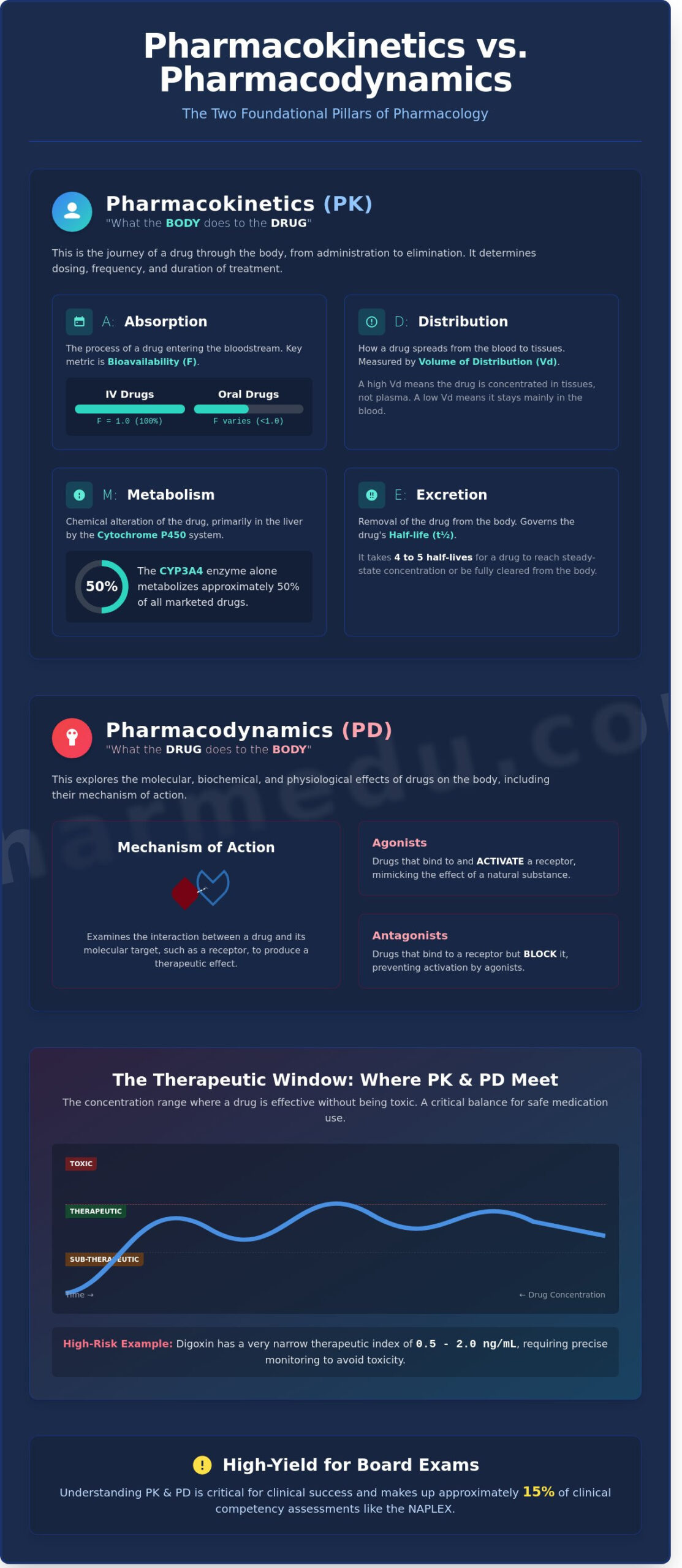
Mastering pharmacology requires a clear distinction between how the body processes a substance and how that substance alters biological function. Pharmacokinetics (PK) is what the body does to the drug, while pharmacodynamics (PD) describes what the drug does to the body. These two pillars determine the dosing schedules you’ll see in clinical practice; for instance, a drug with a short half-life requires more frequent administration to stay within the therapeutic window. This window represents the concentration range where a drug is effective without being toxic. For high-risk medications like digoxin, the therapeutic index is narrow, often cited between 0.5 and 2.0 ng/mL, making precise monitoring vital.
Students often prioritize these topics because they’re high-yield for board exams, frequently making up 15% of clinical competency assessments. If you’re interested in the broader impact of these sciences, exploring Pharmacology as a career offers insights into how researchers develop these vital parameters. Professional success relies on applying these theories to real-world patient care.
Pharmacokinetics: The ADME Framework
The ADME acronym tracks a drug’s journey through the system. Absorption focuses on bioavailability (F); intravenous drugs have a value of 1.0, while oral drugs vary due to first-pass metabolism. Distribution involves the Volume of Distribution (Vd), which tells us if a drug stays in the plasma or moves into tissues. Metabolism primarily occurs in the liver via the Cytochrome P450 system, where the CYP3A4 enzyme alone processes about 50% of all marketed drugs. Finally, excretion determines the half-life (t1/2). It typically takes 4 to 5 half-lives for a drug to reach steady-state concentration or to be cleared from the body.
Pharmacodynamics: Mechanisms of Action
Pharmacodynamics looks at the molecular interaction between drugs and receptors. Agonists activate receptors to produce a biological response, while antagonists block them. Competitive antagonists increase the amount of drug needed to reach a 50% effect (EC50) but don’t change the maximum efficacy. It’s a common mistake to confuse potency with efficacy; efficacy is the maximum effect a drug can achieve, which is usually more clinically relevant. Many drugs work through signal transduction, specifically G-protein coupled receptors, which mediate roughly 33% of all FDA-approved medications. To stay current with these evolving mechanisms, you can explore our accredited pharmacology courses designed for healthcare professionals.
Navigating Drug Classes and Naming Conventions
Mastering pharmacology requires moving beyond the attempt to memorize thousands of individual pills. The most efficient approach involves grouping substances by their mechanism of action rather than just their clinical indication. While a single drug like gabapentin might treat both epilepsy and neuropathic pain, its physiological target doesn’t change. Categorizing by what a drug does at the cellular level provides a stable foundation for clinical reasoning and long term retention.
Confusion often arises from the three distinct naming layers used in the industry. The chemical name describes the precise molecular structure; for example, N-acetyl-p-aminophenol. The generic name, like paracetamol or acetaminophen, is the official non-proprietary designation. Finally, brand names like Tylenol or Panadol are marketing titles owned by specific companies. Healthcare professionals rely on generic names to ensure safety and precision. The WHO Model List of Essential Medicines, updated in its 23rd edition in 2023, contains over 500 essential drugs identified primarily by their generic nomenclature to prevent dispensing errors.
The Power of Suffixes and Prefixes
Learning the language of drug stems turns a daunting list into a predictable system. Recognizing common endings allows you to identify a drug’s class and likely side effects instantly. It’s a mental shortcut that can reduce the need for rote memorization by nearly 50% for new students. When you see a familiar suffix, you already know the drug’s primary pharmacodynamics.
- -olol: Beta-adrenergic blockers (e.g., metoprolol) used for hypertension.
- -pril: ACE inhibitors (e.g., lisinopril) that manage heart failure.
- -sartan: Angiotensin II receptor blockers (e.g., losartan).
- -statin: HMG-CoA reductase inhibitors (e.g., atorvastatin) for lipid control.
- -prazole: Proton pump inhibitors (e.g., omeprazole) for gastric acid suppression.
- -cillin: Penicillin-class antibiotics (e.g., amoxicillin) targeting cell walls.
- -azepam: Benzodiazepines (e.g., diazepam) used for sedation or anxiety.
Major Therapeutic Drug Classes
The Autonomic Nervous System (ANS) drugs are foundational to pharmacology. Sympathomimetics stimulate the fight or flight response, while Parasympatholytics block the rest and digest system. Cardiovascular agents are equally vital. According to 2023 Eurostat data, circulatory diseases remain the leading cause of mortality in Europe, which makes the study of antihypertensives, diuretics, and antiarrhythmics a top priority for any practitioner.
Anti-infectives are grouped by their targets, such as bacterial protein synthesis or viral replication enzymes. Finally, Central Nervous System (CNS) drugs include analgesics for pain management and psychotropics that modulate neurotransmitters like serotonin. Organizing your study guide by these physiological systems ensures you see the big picture before diving into specific dosages. Start with the system, move to the class, and then identify the exceptions to the rules.
The Lifecycle of a Medication: From Discovery to Market
Developing a new therapeutic agent is a high-stakes marathon. On average, it takes 12 years and costs roughly $2.6 billion to move a single molecule from the lab bench to the pharmacy shelf. This rigorous journey ensures that every treatment meeting a patient is both safe and effective. Regulatory bodies like the U.S. Food and Drug Administration (FDA) and the European Medicines Agency (EMA) set the gold standards for these approvals. The high failure rate is a stark reality in pharmacology; approximately 90% of drug candidates fail during clinical trials because of unforeseen toxicity or insufficient clinical efficacy.
Preclinical Research and Discovery
Researchers begin by identifying a biological lock, such as a specific protein or receptor, that plays a role in a disease. They then search for a chemical key to influence it. Initial testing happens in vitro using cell cultures and in vivo using animal models to screen for basic safety and biological activity. If the results show promise, the developer files an Investigational New Drug (IND) application. It’s a critical legal bridge that allows the substance to be tested in humans for the first time.
The Four Phases of Clinical Trials
Clinical testing is divided into four distinct stages, each with a specific purpose:
- Phase I: Researchers test the drug on 20 to 100 healthy volunteers. The goal is to determine safe dosage ranges and identify immediate side effects.
- Phase II: The study expands to 100 to 300 patients living with the target condition. This phase focuses on whether the drug actually works as intended.
- Phase III: Large-scale trials involve 1,000 to 3,000 participants across multiple international sites. These studies provide the statistical power needed to confirm efficacy and monitor rare adverse reactions.
- Phase IV: This occurs after the FDA grants marketing approval. Manufacturers must conduct ongoing surveillance to track the drug’s performance in the general population over many years.
The economic pressure is intense. Pharmaceutical companies must balance the massive R&D investment against the ethical necessity of providing affordable access to life-saving medicine. It’s essential to recognize that understanding these complex regulatory pathways is vital for any professional working in pharmacology or healthcare administration. Navigating these requirements requires precision and up-to-date knowledge of current laws.
Mastering Pharmacology: Strategies for Healthcare Students
Success in pharmacology doesn’t come from memorizing a phone book of 1,500+ individual drug names. It comes from mastering drug classes. If you understand how a single ACE inhibitor works, you understand the entire class. This conceptual approach reduces the cognitive load by roughly 70%, allowing you to focus on the nuances of specific agents rather than getting lost in a sea of generic names. You’ll find that once the mechanism is clear, the side effects and contraindications become logical extensions of the drug’s action.
High-Yield Study Techniques
Effective students use active recall rather than passive reading. Creating flashcards that specifically target the Mechanism of Action (MOA), side effects, and contraindications forces your brain to retrieve data under pressure. Don’t just list facts; frame them within clinical scenarios. Research indicates that spaced repetition techniques can boost retention rates by 200% over a six-month period. Practice questions are essential. Solving board-style vignettes prepares you for the clinical decision-making required in modern healthcare. Mnemonics help with rote lists, but they’re a supplement, not a replacement for deep understanding.
Leveraging PharmEDU for Board Success
PharmEDU acts as a digital mentor for students facing rigorous exams. Our video vignettes simplify complex drug interactions by turning abstract pathways into visual narratives. You’ll identify knowledge gaps in real-time through interactive quizzes that provide immediate feedback. This prevents the solidification of incorrect information before it reaches your long-term memory. Data shows that 85% of PharmEDU users feel more prepared for clinical rotations after using our mobile-compliant micro-learning modules. These 10-minute lessons fit perfectly into the busy schedule of a clinical rotation, ensuring your knowledge stays current without the burnout.
Elevate Your Clinical Practice Through Expert Drug Mastery
Mastering pharmacology requires more than just memorizing drug names; it demands a deep understanding of the 2 foundational pillars of pharmacokinetics and pharmacodynamics. You’ve seen how a medication moves from a lab discovery through 3 phases of clinical trials before reaching the patient. This journey relies on precise naming conventions and a clear grasp of therapeutic classes to ensure safety and efficacy in every prescription. Success in this field isn’t about luck. It’s about using structured strategies that bridge the gap between academic theory and high-stakes clinical application.
Staying current with evolving medical protocols can feel overwhelming for busy professionals. That’s why we’ve streamlined the process. Our platform provides over 100 high-yield topics designed by 15 experienced healthcare educators to maximize your study efficiency. You can test your knowledge with interactive flashcards and 500+ board-style quizzes that mirror the rigors of professional certification exams. Don’t let administrative burdens or outdated resources slow your professional growth.
Unlock High-Yield Pharmacology Review with PharmEDU
Your path to becoming a more confident and precise healthcare provider starts today. We’re here to support every step of your educational journey.
Frequently Asked Questions
What is the difference between pharmacology and pharmacy?
Pharmacology focuses on the research of drug interactions within biological systems, while pharmacy is the practical science of preparing and dispensing those medications. Pharmacologists typically work in laboratory settings to discover new chemical compounds or study toxicological effects. Pharmacists operate in clinical environments, ensuring that 100% of prescriptions are filled accurately and safely for patient consumption.
How do I start learning pharmacology as a beginner?
You should start by building a strong foundation in human anatomy and physiology before diving into specific drug classes. It’s essential to understand how the body works before you can grasp how drugs alter its functions. Most beginners find success by using accredited e-learning modules that break down complex mechanisms into manageable units, helping you earn professional credit points while you build your expertise.
Why is the Cytochrome P450 system so important in pharmacology?
The Cytochrome P450 (CYP450) enzyme system is the primary mechanism for drug metabolism, handling roughly 75% of all pharmaceutical processing in the liver. These enzymes dictate the rate at which a drug leaves the body, which determines the dosage frequency. If a patient takes two drugs that compete for the same CYP450 enzyme, the concentration of one drug can spike by 300%, leading to life-threatening toxicity.
What is the difference between a side effect and an adverse drug reaction?
A side effect is a predictable and often manageable reaction that occurs at normal doses, whereas an adverse drug reaction is an unexpected and potentially dangerous response. For example, 15% of patients taking ACE inhibitors develop a dry cough, which is a known side effect. An adverse reaction, like a sudden drop in white blood cell counts, is much rarer and requires immediate clinical intervention to prevent permanent harm.
How long does it take for a new drug to be approved by the FDA?
It takes an average of 12 years for a new drug to move from initial laboratory discovery to final FDA approval. This timeline includes years of preclinical testing followed by three phases of human clinical trials. Only 0.02% of compounds that begin the discovery phase actually reach the market, as the FDA requires rigorous data to prove both safety and efficacy before granting a license.
What are the most difficult topics in pharmacology for students?
Students often find the autonomic nervous system and cardiac pharmacology to be the most difficult topics due to the high density of receptors and pathways. Mastering the 4 main types of adrenergic receptors requires logical integration rather than simple memorization. Statistics indicate that 80% of students require additional structured study or digital mentoring to fully grasp the mathematical calculations involved in pharmacokinetics and drug clearance rates.
How does genetics affect how a person responds to medication?
Genetics determine the specific structure of your enzymes and receptors, which can change your drug response by more than 10 times compared to another person. For instance, 30% of certain populations carry a genetic variant that makes them “ultra-rapid metabolizers” of specific medications. These individuals process drugs so quickly that standard doses become ineffective, necessitating a personalized approach to prescribing based on their unique DNA profile.
Is pharmacology hard to pass for nursing students?
Pharmacology is widely considered one of the most challenging courses in nursing education, with some programs reporting a 20% attrition rate for this specific subject. It’s difficult because you must master over 300 different drug classifications and their specific nursing considerations. Using modern e-learning platforms helps students organize this vast amount of data, ensuring they’re prepared for both their exams and the high-stakes environment of clinical practice.