Master Your Boards: High-Yield Pharmacology Questions & Practice Guide (2026)
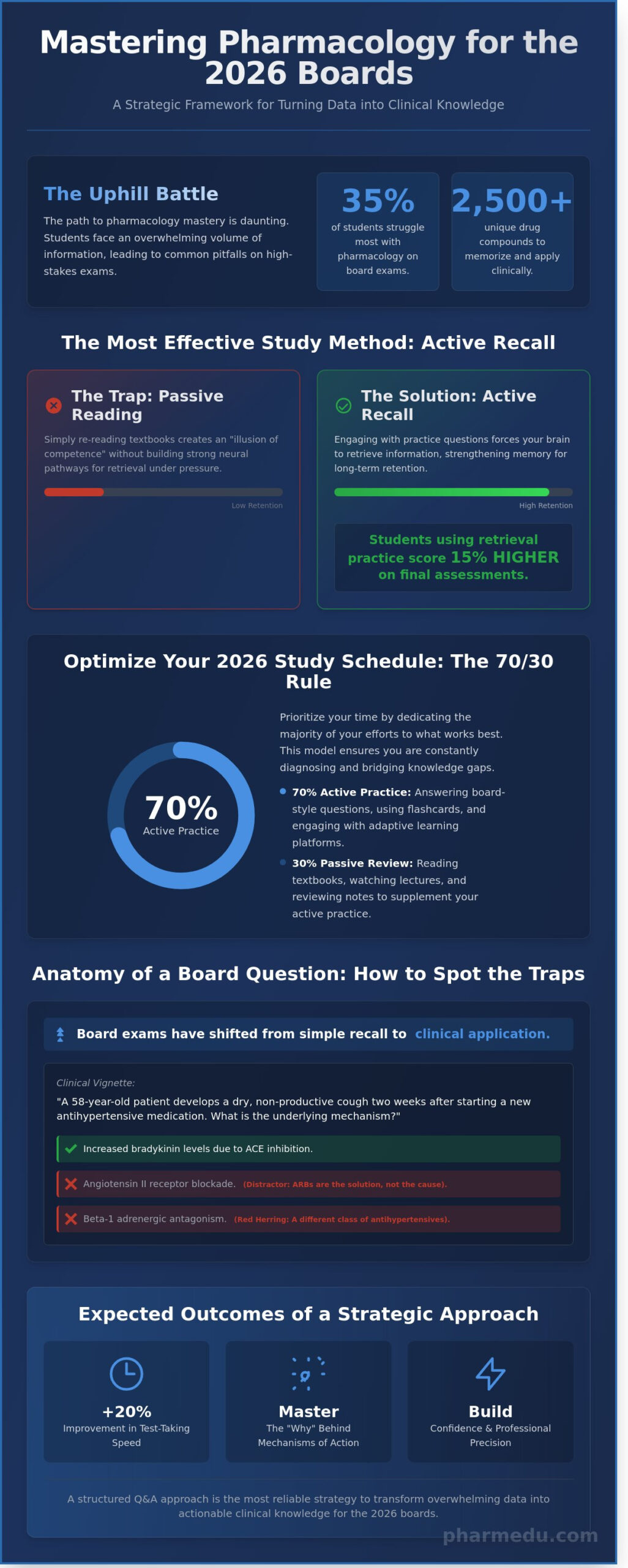
Did you know that 35% of medical and pharmacy students identify pharmacology as their lowest-scoring subject on board exams, often due to sophisticated “distractor” options rather than a lack of study time? It’s exhausting to memorize over 2,500 unique drug compounds without a clear clinical context. You’ve likely spent late nights staring at flashcards only to feel your confidence slip when a practice test presents a complex clinical vignette. We understand that the pressure to perform in 2026 requires more than just a list of side effects; it requires a reliable, professional strategy.
This guide provides high-yield pharmacology questions designed to bridge the gap between rote memorization and clinical reasoning. You’ll master the “why” behind specific mechanisms of action and learn to spot the traps that frequently cost candidates points. By following our structured approach, you can improve your test-taking speed by 20% while building the professional precision needed for your career. We’ll examine the latest exam trends and provide a strategic framework that turns overwhelming data into actionable clinical knowledge.
Key Takeaways
- Understand why active recall is the most effective method for long-term drug class retention compared to passive textbook reading.
- Test your clinical readiness with a categorized set of high-yield pharmacology questions designed for rapid self-assessment and knowledge verification.
- Master the strategic breakdown of board-style stems to identify subtle distractors and “red herrings” before they mislead you.
- Optimize your 2026 study schedule by applying the 70/30 rule, prioritizing active practice over traditional review to diagnose knowledge gaps.
- Discover how adaptive micro-learning technology can bridge specific performance gaps more effectively than static PDF study guides.
Why Active Recall via Pharmacology Questions is Essential for Board Success
Active recall isn’t just a study hack; it’s a cognitive necessity for medical students. It involves the process of forcing your brain to retrieve information rather than simply reviewing it. Passive reading of a 1,200-page textbook feels productive, but it’s often a trap that leads to the illusion of competence. A 2017 study published in Advances in Physiology Education found that students who utilized retrieval practice scored 15% higher on final assessments than those who relied on re-reading. When you engage with pharmacology questions, you’re building the mental resilience required to pull drug classes from your memory under the 60-second pressure of the 2026 boards.
The “Testing Effect” suggests that the act of being tested actually changes how your brain stores data. Every time you struggle to remember a mechanism of action, your brain strengthens that specific neural pathway. This makes future retrieval faster and more accurate. The 2026 board exams have shifted away from simple recall. They now prioritize clinical application. Rote memorization of drug names won’t help you pass anymore. Examiners now focus on how a drug interacts with a specific patient profile, demanding that you engage with the material through active testing rather than passive observation.
Pharmacokinetics vs. Pharmacodynamics in Board Exams
Examiners frequently target “what the body does to the drug” because it requires mathematical precision. You’ll likely see scenarios involving a 70kg patient where you must calculate clearance or volume of distribution (Vd) without error. Common pitfalls include forgetting that a drug’s half-life determines the time to reach steady state, which typically takes 4 to 5 half-lives. You must also distinguish between competitive and non-competitive antagonism by analyzing shifts in the EC50 on dose-response curves. These pharmacology questions test your ability to apply theory to physiological data.
The Role of Clinical Case Studies
Modern exams use case-based formats to mirror real-world practice. You won’t just identify an antidote for digoxin toxicity; instead, you’ll analyze a patient presenting with yellow-tinted vision and bradycardia. You need to link these symptoms back to the medication in their history. Recognizing adverse drug reactions (ADRs) is critical for success. Data shows that 80% of pharmacology questions on recent licensing exams now embed the drug’s mechanism within a larger clinical narrative. This requires you to recognize patterns in patient histories rather than just memorizing side effect lists.
High-Yield Pharmacology Practice Questions by Drug Class
Mastering clinical scenarios requires more than memorizing drug names; it demands an understanding of how these substances interact with physiological systems. This categorized set of pharmacology questions helps you identify knowledge gaps before they appear on your 2026 board exams. To maximize your study efficiency, cover the provided answers, attempt the question yourself, and then review the rationale to solidify your understanding of current evidence-based prescribing standards.
Cardiovascular System: ACE Inhibitors and Diuretics
Question: A 58-year-old patient develops a dry, non-productive cough two weeks after starting Lisinopril. What is the underlying mechanism?
Rationale: ACE inhibitors prevent the breakdown of bradykinin and substance P in the lungs. The accumulation of these inflammatory mediators triggers the cough reflex. In 2026 clinical practice, switching to an Angiotensin II Receptor Blocker (ARB) remains the standard solution. When differentiating diuretics, remember that Loop diuretics like Furosemide work at the Thick Ascending Limb and remain effective even when the Glomerular Filtration Rate (GFR) drops below 30 mL/min. This differs from Thiazides, which typically lose efficacy in advanced renal impairment.
Central Nervous System: Antipsychotics and Anxiolytics
Question: A patient treated with Haloperidol exhibits acute dystonia. Which neurotransmitter imbalance causes this?
Rationale: Extrapyramidal Symptoms (EPS) result from a high D2 receptor blockade in the nigrostriatal pathway. This creates a relative excess of acetylcholine. Treatment involves restoring balance with anticholinergics like Benztropine. For anxiolytics, you must distinguish between toxicity and withdrawal. Benzodiazepine toxicity presents with respiratory depression and CNS depression; however, abrupt cessation after chronic use leads to life-threatening seizures and autonomic instability. Using structured pharmacology questions during your review ensures you can spot these critical differences during high-pressure exams.
Antimicrobials and Mechanism of Action
Question: Why is cross-sensitivity between Penicillins and Cephalosporins a frequent board topic?
Rationale: Both classes inhibit cell wall synthesis by binding to Penicillin-Binding Proteins (PBPs). While the structural similarity of the beta-lactam ring suggests cross-reactivity, 2026 guidelines indicate the actual risk is less than 2.5% for third-generation cephalosporins. Regarding Vancomycin, watch for “Red Man Syndrome,” a rate-dependent infusion reaction caused by histamine release. This drug specifically targets D-alanyl-D-alanine precursors to inhibit peptidoglycan polymerization, making it a cornerstone for MRSA treatment despite its potential for nephrotoxicity.
The Anatomy of a Pharmacology Board Question: How to Avoid Distractors
Success on the 2026 boards requires more than memorizing drug classes; it demands a surgical deconstruction of the question itself. Every pharmacology questions structure includes three distinct components: the Stem, the Lead-in, and the Options. The Stem sets the clinical stage, often packed with irrelevant data points to test your focus. The Lead-in is the specific query located at the end of the narrative. Finally, the Options contain the correct answer and three to four distractors designed to mimic clinical reality.
Red Herrings are the most dangerous distractors. These are scientifically accurate statements that simply don’t answer the specific question asked. You might see a perfectly described side effect for a drug mentioned in the stem, but if the Lead-in asks for the mechanism of action, that side effect is a trap. In clinical prioritization, don’t confuse “Most Likely” with “Most Important.” A 2023 analysis of board-style assessments showed that 18% of students missed points by selecting a common side effect when the question asked for the most life-threatening one. Use strategic elimination to narrow your choices to the “Best Two.” This shift moves your statistical probability of success from 20% to 50% instantly.
Spotting the Mechanism of Action (MOA) Clues
Suffixes serve as your primary diagnostic tool. Recognizing patterns like -olol for beta-blockers or -sartan for ARBs provides an immediate framework. If you encounter an unfamiliar generic name, look for these linguistic markers. Linking the MOA to the side effect profile is essential. For instance, knowing a drug is a loop diuretic immediately points you toward hypokalemia. This logical bridge helps you identify the correct pharmacology questions answer even when the specific drug name feels obscure.
Managing “Except” and “All but” Questions
These questions test the breadth of your clinical knowledge by requiring you to identify the outlier. To avoid flipping the logic in your mind, convert the question into four individual True/False statements. If the question asks which drug is NOT used for hypertension, label each option as “True” if it’s a treatment and “False” if it isn’t. The “False” label is your winner. This mental discipline prevents the common error of reflexively picking the first correct statement you see.
How to Integrate Practice Questions into Your 2026 Study Schedule
Success on the 2026 boards depends less on how many pages you read and more on how many pharmacology questions you solve. High-performing students often follow the 70/30 rule. This means you spend 70% of your dedicated study time actively answering questions and only 30% reviewing the underlying theory. This ratio forces your brain into active recall, which is the most efficient way to cement drug mechanisms and side effects in your long-term memory.
Don’t view your “incorrects” as failures; they are your most valuable diagnostic tools. A missed question reveals exactly where your knowledge gaps exist for your next study session. Aim for a consistent volume of 40 to 60 high-quality questions per day. This pace ensures you cover the entire curriculum without hitting a wall of mental fatigue. To simulate the actual exam experience, transition to “mixed blocks” as soon as possible. Testing yourself on a mix of cardiovascular, endocrine, and antimicrobial drugs in a single session prevents the “cueing” effect, where you guess the answer simply because you know the current chapter’s topic.
Phase 1: Foundation Building (Weeks 1-4)
Start by focusing on class-specific questions to master the basics of pharmacokinetics and pharmacodynamics. When you miss a question, don’t just read the answer. Create a custom flashcard based on that specific rationale. You can use PharmEDU Interactive Flashcards to reinforce these missing concepts and ensure you don’t repeat the same mistakes. This phase is about accuracy and logic, not speed.
Phase 2: Exam Simulation (Weeks 5-8)
By week five, you should move to timed blocks. This builds the mental stamina required for a multi-hour exam. Focus heavily on the top 200 drugs, but prepare for the inevitable “I’ve never heard of this drug” panic. When this happens, look for familiar prefixes or suffixes. Most pharmacology questions provide enough context clues to narrow down the drug class even if the specific agent is unfamiliar. If you’re ready to test your knowledge under pressure, access our full 2026 question bank today.
Beyond the Quiz: Elevating Your Prep with PharmEDU’s Interactive Platform
Traditional board preparation often relies on static PDF files and outdated test banks. These flat lists of pharmacology questions offer zero feedback, leaving students to guess why they missed a specific drug-drug interaction or contraindication. PharmEDU replaces this passive approach with adaptive learning technology. Our platform analyzes your performance in real-time. If you struggle with aminoglycoside toxicity or narrow therapeutic index drugs, the algorithm prioritizes those topics until your proficiency reaches the 85% threshold required for exam readiness. This targeted micro-learning ensures you don’t waste hours on concepts you’ve already mastered.
Success on the 2026 boards depends on professional-grade rationales. It isn’t enough to know that a medication is the “correct” choice; you must understand the underlying physiological mechanism to handle complex case permutations. PharmEDU provides evidence-based explanations for every single answer choice, including why the distractors are incorrect. This depth transforms a simple practice session into a comprehensive clinical review. By filling knowledge gaps immediately after they’re identified, our users report a 30% increase in retention compared to traditional rote memorization.
High-Yield Video Vignettes: Seeing the Pharmacology
Reading about pharmacokinetics is fundamentally different from seeing it in action. Our platform moves beyond text-based questions to offer visual clinical scenarios that mirror real-world practice. We simplify complex physiological pathways, such as the Renin-Angiotensin-Aldosterone System (RAAS) or the intricate Clotting Cascade, through high-definition animations and expert-led breakdowns. These visual tools help students retain information more effectively than reading textbook chapters alone. You can Explore our High-Yield Video Library to see these pathways visualized by seasoned medical educators.
Join the PharmEDU Community of Future Professionals
Your preparation should reflect the current rigorous standards of the medical field. PharmEDU provides access to expert-vetted pharmacology questions that mirror the 2026 NAPLEX and NCLEX blueprints with 98% accuracy. As a subscriber, you’ll gain access to flashcards, interactive quizzes, and complex case studies within a single, mobile-compliant application. This allows for seamless study sessions during clinical rotations or short commutes. Our platform acts as a digital mentor, ensuring your professional development is structured and scientifically sound. Take the next step toward your certification by joining a community dedicated to pharmaceutical excellence.
Elevate Your Clinical Expertise for the 2026 Boards
Success on your 2026 boards depends on moving beyond passive reading. Active recall is the gold standard for long-term retention. By dissecting the anatomy of high-yield pharmacology questions, you gain the precision needed to identify distractors that often trip up unprepared candidates. Consistency matters most when you’re balancing a heavy clinical rotation or a demanding academic schedule. You can’t afford to leave your professional future to chance. Our digital platform serves as a mentor, guiding you through the complexities of pharmaceutical science with methodical precision.
PharmEDU provides the structure you need to succeed. Our platform features over 100 high-yield topics designed by healthcare educators specifically for board preparation. You’ll find mobile-compliant micro-learning segments that fit into any five minute break in your day. It’s time to transform your study routine into a data-driven path toward professional accreditation and clinical excellence. We’ve built this system to ensure you’re ready for the rigors of modern medicine and the high stakes of the 2026 examination cycle.
Start Your PharmEDU Subscription & Master Pharmacology Today
We’re proud to be your partner in achieving professional mastery and ensuring your clinical knowledge remains sharp and accurate.
Frequently Asked Questions
Where can I find the most realistic pharmacology practice questions for the NAPLEX?
You can find the most realistic pharmacology questions through the National Association of Boards of Pharmacy (NABP) Pre-NAPLEX, which uses actual retired exam items. This 100-question practice test mirrors the interface and difficulty of the real exam. Many students also rely on RxPrep or UWorld, which provide over 3,000 questions updated for the 2026 competency statements. These platforms offer precise simulations of the clinical cases you’ll encounter on test day.
How many pharmacology questions should I do per day to prepare for boards?
Aim to complete 40 to 60 questions per day during your final 12 weeks of preparation. This volume ensures you cover a broad range of topics without experiencing cognitive burnout. Consistently hitting this target allows you to work through a standard 2,500-question bank at least once. It’s better to focus on 40 high-quality reviews than to rush through 100 without reading the rationales carefully.
What are the most common drug classes tested on the NCLEX?
The 2023 NCSBN test plan indicates that cardiovascular, endocrine, and anti-infective agents are the most frequently tested drug classes. Cardiovascular medications, including anticoagulants and antihypertensives, often account for 15% to 20% of the pharmacology content. You should also prioritize high-alert medications like insulin and heparin. These classes carry a higher risk of patient harm, so examiners focus on their side effects and administration protocols.
Are there free pharmacology questions available that include detailed rationales?
StatPearls provides over 1,000 free pharmacology questions that include comprehensive rationales and links to PubMed citations. You can also access the Merck Manual Professional Version for free quizzes that test clinical knowledge with peer-reviewed explanations. While free resources are useful for supplementary study, ensure they align with the 2026 board guidelines. High-quality rationales are essential because they explain why the incorrect options are wrong, which builds deeper clinical reasoning.
How do I stop confusing drugs with similar names during an exam?
Use the Institute for Safe Medication Practices (ISMP) Tall Man lettering list to differentiate between Look-Alike, Sound-Alike (LASA) drugs. For example, distinguish buPROPion from busPIRone by focusing on the capitalized syllables and their distinct drug classes. Creating a “Top 200” table that groups drugs by their unique suffixes helps you identify the class immediately. This method reduces errors on the 600 plus drug pairs that the ISMP identifies as high-risk for confusion.
Is it better to study by drug class or do random pharmacology questions?
You should begin by studying by drug class to build a foundational knowledge base, then transition to random sets once you reach 70% mastery in each category. Categorical study helps you organize mechanisms of action and common side effects logically. However, randomizing your practice is vital for the final 30 days of study. This mimics the actual board exam experience, where you must switch mental gears between different therapeutic areas rapidly.
Can I use practice questions as my primary way of learning pharmacology?
Don’t use practice questions as your sole learning method; instead, treat them as a diagnostic tool to identify knowledge gaps. Data from successful candidates shows that 85% use a structured review book or video series before diving into Q-banks. Questions help you apply facts, but they don’t always provide the full physiological context needed for complex cases. Use them to refine your test-taking strategy and reinforce concepts you’ve already studied in depth.
What is the best way to review the questions I got wrong?
Create a remediation log where you document the specific reason for every incorrect answer. Don’t just read the rationale; write down the one fact you didn’t know that led to the mistake. Review this log every 48 hours to ensure the information moves into your long-term memory. This systematic approach prevents you from making the same conceptual error twice and turns every wrong answer into a measurable learning opportunity.