How to Become a Pharmacist: The Complete 2026 Career Guide
Did you know that the NAPLEX first-time pass rate for pharmacy graduates dropped to 77.5% in 2023? This data point highlights the increasing complexity of the industry and the rigorous standards you must meet to practice. Understanding how to become a pharmacist in 2026 requires more than just a passion for science; it demands a precise, strategic approach to your education and professional development. You’re likely feeling the pressure of choosing between various pre-pharmacy tracks while weighing the significant financial investment against your future career stability. It’s natural to feel anxious about the transition from academic theory to the high-stakes environment of board exams.
This guide provides a comprehensive roadmap to help you manage these challenges with professional confidence. We’ll clarify the distinction between pre-pharmacy and PharmD requirements and offer a step-by-step checklist for your licensure journey. You’ll also learn the critical differences between retail and clinical roles, along with the specific study habits necessary to excel in your exams. This article serves as your digital mentor, providing the clarity you need to move from student to licensed professional without the administrative or academic guesswork.
Key Takeaways
- Understand the modern healthcare landscape and how the pharmacist’s role is shifting toward primary care and specialized clinical services.
- Master the multi-step educational path of how to become a pharmacist, starting from undergraduate prerequisites to maintaining a competitive GPA for PharmD admission.
- Learn how to differentiate yourself in a competitive market by navigating advanced post-graduate pathways and specialized residency training.
- Identify the critical legal and clinical requirements of the NAPLEX and MPJE exams to ensure a smooth transition into professional practice.
- Discover how to bridge the gap between academic theory and clinical practice using efficient micro-learning strategies designed for busy students.
The Evolving Role of the Pharmacist in 2026
The modern pharmacist acts as a primary healthcare provider and the ultimate medication expert within the medical team. In 2026, the profession has moved far beyond the traditional image of simply filling prescriptions. Today’s practitioners utilize advanced clinical data to manage patient outcomes directly, often serving as the final check in a complex diagnostic chain. With the U.S. Census Bureau projecting that adults aged 65 and older will outnumber children by 2034, the pharmacist’s expertise in managing polypharmacy and complex drug-drug interactions is a critical safety net for public health. You’ll find these professionals interpreting genomic data to personalize therapy or managing chronic diseases through collaborative practice agreements in various settings. It’s a high-impact career that offers stability; the median annual wage reached $132,750 in 2023, reflecting the high level of responsibility required. Learning how to become a pharmacist starts with understanding this shift from product-centered to patient-centered care.
Clinical vs. Retail: Understanding Your Career Options
Community pharmacists serve as the most accessible healthcare point for the public. They administer roughly 70% of all COVID-19 and flu vaccinations in the U.S. while providing essential counseling on medication adherence and preventative care. In contrast, clinical pharmacists work in hospital settings, often rounding with physicians to optimize drug regimens for acute cases in the ICU or emergency department. Emerging tele-pharmacy roles allow experts to review prescriptions and consult patients remotely, expanding access to rural areas where a physical pharmacy might be miles away. Pharmaceutical industry positions offer a different path, focusing on regulatory affairs and the development of novel therapeutics in laboratory environments where they guide drug trials and safety protocols.
The 6-to-8 Year Roadmap at a Glance
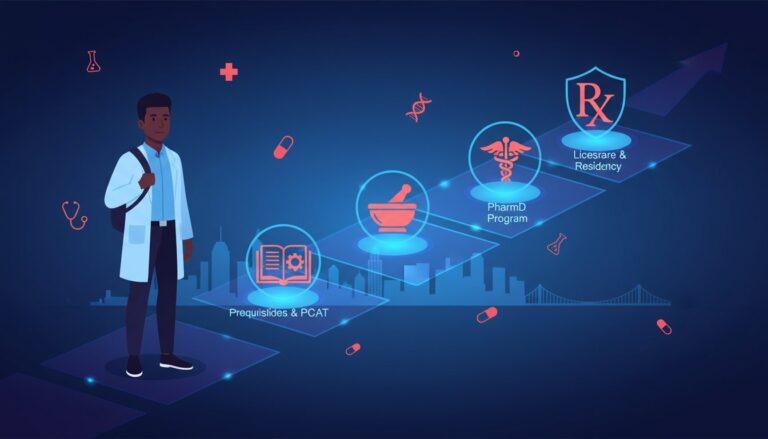
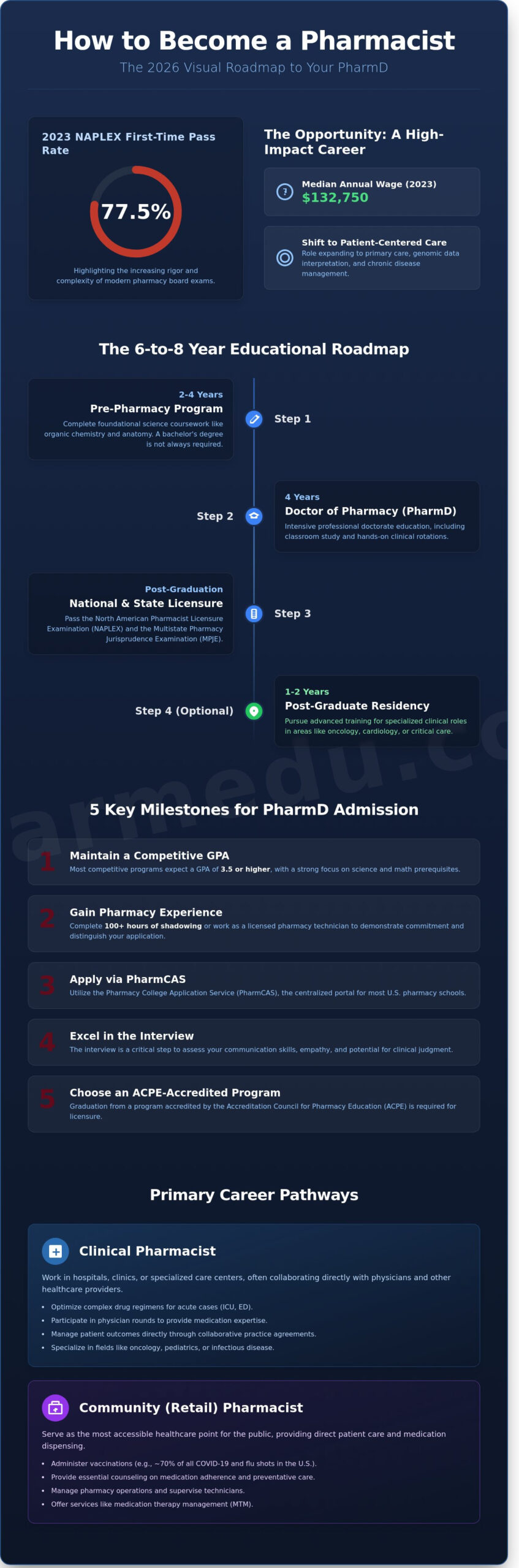
The journey typically spans six to eight years of rigorous academic and professional training. Most students complete two to three years of undergraduate “pre-pharmacy” coursework before entering a four-year Doctor of Pharmacy (PharmD) program. You don’t always need a full bachelor’s degree to gain admission, provided you meet the specific science prerequisites like organic chemistry and anatomy. After graduation, passing the NAPLEX and MPJE exams is mandatory for state licensure.
- Pre-Pharmacy: 2 to 4 years of foundational science coursework.
- PharmD Program: 4 years of professional doctorate education.
- Licensure: Passing scores on national and state law exams.
- Residency (Optional): 1 to 2 years for clinical specialization.
If you’re wondering How long does it take to become a pharmacist?, the timeline depends on your chosen specialty. Understanding how to become a pharmacist requires planning for these specific academic and professional milestones early in your education to ensure you meet all accreditation standards.
Navigating the PharmD Educational Requirements
The journey to the pharmacy counter is a structured, multi-year commitment that demands academic precision and practical exposure. Understanding how to become a pharmacist starts with a clear roadmap of five essential milestones. First, you’ll spend 2 to 4 years completing undergraduate pre-pharmacy coursework. Most competitive programs expect a GPA of 3.5 or higher, particularly in your science and math prerequisites. While your grades provide the foundation, admissions committees also look for early professional commitment. Gaining pharmacy experience, such as completing 100 hours of shadowing or working as a licensed pharmacy technician, distinguishes your application from the crowd.
Once you’ve met these preliminary benchmarks, the formal application process begins. You’ll apply through the Pharmacy College Application Service (PharmCAS), a centralized portal used by most institutions. If your credentials meet their standards, you’ll be invited to an interview, which is a critical step to assess your communication skills and clinical potential. The final stage is graduating from an ACPE-accredited Doctor of Pharmacy program, which typically involves four years of intensive classroom study and clinical rotations. This structured path is the industry standard for anyone learning how to become a pharmacist in the United States.
Pre-Pharmacy Coursework and the PCAT Shift
Admissions committees prioritize mastery in core sciences to ensure you can handle the rigors of pharmacology. You’ll need to excel in Organic Chemistry, Biology, Physics, and Calculus. While many students choose to major in Chemistry or Biochemistry, you can select any undergraduate major if you complete all required prerequisites. The testing landscape has also shifted significantly. The PCAT (Pharmacy College Admission Test) was officially retired in January 2024. By the 2026 admission cycle, almost all accredited programs will have fully transitioned away from this exam, placing even more weight on your cumulative GPA and hands-on experience.
Is a Pharmacist a Doctor? The PharmD Explained
A common point of confusion for many students is is a pharmacist a doctor? The answer is yes, but it’s important to understand the distinction. A PharmD is a professional doctorate focused on clinical practice, whereas a PhD is a research doctorate focused on original scientific discovery. In a healthcare setting, the “Doctor” title carries immense clinical weight. You aren’t just dispensing medication; you’re making life-saving interventions, managing complex drug therapies, and consulting with physicians on patient care plans. This level of responsibility requires a commitment to ongoing professional development to stay current with evolving medical standards.
Specialization and Advanced Career Pathways
Understanding how to become a pharmacist involves more than just passing the NAPLEX. In 2023, approximately 5,800 pharmacy students participated in the ASHP Resident Matching Program, reflecting a 5.6 percent increase in applicants over the previous five years. This trend stems from a competitive job market where clinical roles often demand expertise beyond the entry-level PharmD degree. While the initial steps of how to become a pharmacist focus on basic licensure, these advanced pathways define your long-term career ceiling.
Choosing a residency means accepting a temporary financial dip. While a retail pharmacist in many regions might earn $125,000 annually, a PGY1 resident typically receives a stipend between $45,000 and $55,000. This $70,000 gap represents a calculated investment in professional stability. Board certification acts as the gold standard for these specialized practitioners. The Board of Pharmacy Specialties (BPS) recognizes 14 different specialties. Earning a Board Certified Pharmacotherapy Specialist (BCPS) or Board Certified Oncology Pharmacist (BCOP) credential signals to employers that you possess the advanced knowledge required for high-stakes patient care.
Residencies and Fellowships: When Are They Necessary?
A residency is a clinical commitment focused on direct patient care. PGY1 (Post-Graduate Year One) builds a foundation in general pharmacy practice, while PGY2 allows for deep specialization. If your goal is a position at a leading health system or a prominent specialized hospital, completing at least a PGY1 is often a non-negotiable requirement. Fellowships differ by focusing on research or pharmaceutical industry roles, lasting two years. These programs are essential for those aiming for careers in drug development or medical affairs within major global pharmaceutical firms or biotech startups.
- PGY1: General clinical training in hospitals or clinics.
- PGY2: Specialized training in areas like Infectious Disease or Critical Care.
- Fellowships: Focus on academic research, drug discovery, or regulatory affairs.
Emerging Fields: Pharmacogenomics and Digital Health
The role of the pharmacist is evolving into data management and personalized medicine. Pharmacogenomics uses a patient’s genetic profile to predict drug response, reducing the risk of adverse reactions which cost the U.S. healthcare system $528 billion annually. Pharmacists are now the primary interpreters of this genetic data. Digital health is another growing frontier. You’ll find pharmacists managing digital therapeutics, which are software-driven, evidence-based interventions. Future-proof professionals must master these technological tools to remain relevant. It’s no longer enough to understand chemistry; you must be tech-literate and capable of analyzing complex health datasets to drive patient outcomes.
Conquering the NAPLEX and State Licensure
Completing your PharmD is a massive achievement, but you aren’t a licensed professional quite yet. You must clear two final legal hurdles to secure your credentials: the NAPLEX and the MPJE. These exams verify that you possess the clinical knowledge and legal understanding to protect public health. If you’re researching how to become a pharmacist, you’ll find that these tests are the ultimate gatekeepers to your career in the Cincinnati area and beyond.
The NAPLEX, or North American Pharmacist Licensure Examination, evaluates your readiness to practice safely. It focuses heavily on effective pharmacotherapy, safe medication preparation, and precise clinical calculations. You’ll face 225 questions over a six-hour period. While the NAPLEX is a national standard, the MPJE (Multistate Pharmacy Jurisprudence Examination) is state-specific. For those practicing in Cincinnati, you’ll likely take the Ohio MPJE, which tests your knowledge of both federal regulations and the specific Ohio Revised Code and Administrative Code rules that govern local pharmacies.
Understanding the NAPLEX Framework
You register for these exams through the National Association of Boards of Pharmacy (NABP). The framework covers six critical competency areas, including drug delivery, management of pharmacy systems, and clinical decision making. Passing on your first try is essential for maintaining your career momentum and starting your residency or job on schedule. In 2023, the national pass rate for first-time candidates sat at 77.5 percent, which illustrates the difficulty of the task. To ensure you’re part of the passing group, you need a structured approach. Master the NAPLEX with our 2026 prep guide.
High-Yield Study Strategies for Pharmacology Mastery
Pharmacology is the central pillar of the exam and is often the “make or break” subject for graduates. Don’t rely on passive reading or highlighting textbooks. Instead, use active recall and spaced repetition to cement drug mechanisms and side effects in your long-term memory. High-yield study focuses on the 20% of drug classes that make up 80% of clinical decisions. This targeted approach ensures you spend your time on the medications you’ll actually see on the test and in the clinic. The path of how to become a pharmacist requires this level of strategic preparation to ensure you can handle the complexities of modern drug therapy. For healthcare students who need to master similar concepts, our pharmacology study guide for nursing students provides a complementary framework that emphasizes clinical application and patient safety.
- Focus on top 200 drugs and their primary indications.
- Practice at least 20 complex dosage calculations daily.
- Review Ohio-specific laws regarding mid-level practitioners and controlled substance refills.
Ready to secure your license? Explore our accredited licensure prep courses to ensure you’re prepared for exam day.
Accelerating Your Pharmacy Journey with PharmEDU
The transition from a student to a licensed professional is the most demanding phase of your career. Understanding how to become a pharmacist requires more than just memorizing textbooks; it demands the ability to apply complex data in high-pressure clinical settings. PharmEDU serves as the vital bridge between academic theory and the practical realities of the pharmacy floor. We’ve developed a micro-learning framework that respects your schedule. Since 2018, our platform has focused on delivering high-impact knowledge in segments under 15 minutes, making it possible to study effectively even during a 12-hour hospital rotation.
Our high-yield video vignettes take difficult drug mechanisms, like the complexities of monoclonal antibodies or advanced pharmacokinetics, and simplify them into clear, visual narratives. These aren’t just lectures; they’re targeted sessions designed to improve comprehension. To reinforce this knowledge, we provide interactive flashcards that utilize spaced repetition algorithms. Data shows that students using these active recall methods improve their long-term retention by up to 45% compared to passive reading. This structured approach ensures you don’t just learn the material for a Friday quiz, but retain it for your entire professional life.
Bridging the Gap Between Classroom and Boards
Success in the Cincinnati area’s competitive healthcare market requires passing the NAPLEX and MPJE on your first attempt. PharmEDU content is meticulously mapped to both PharmD curricula and the latest NAPLEX blueprints. We provide robust institutional support, currently used by over 30 pharmacy programs to supplement their internal teaching. Our clinical case studies are built on real-world data from the past 24 months, forcing you to make decisions about dosing, contraindications, and patient counseling. These scenarios prepare you for the 150-question format of the boards and the life-or-death decisions you’ll make in a clinical setting.
Study Anywhere: The Mobile-First Learning Advantage
Modern pharmacy education doesn’t happen exclusively at a desk. Our mobile-compliant platform allows you to access 100% of our library from any smartphone or tablet. This flexibility is essential when you’re moving between different rotation sites in the Greater Cincinnati area. Individual subscription benefits include access to thousands of practice questions and updated drug monographs that reflect the 2024 FDA approvals. You’ll have a digital mentor in your pocket, providing the safety net needed as you refine your clinical judgment. It’s time to move beyond traditional study methods and embrace a more efficient way to learn. Start your pharmacology mastery today with PharmEDU.
Launch Your Pharmacy Career with Confidence
The healthcare landscape of 2026 demands a new level of clinical precision and adaptability from pharmacy professionals. You’ve learned that the journey requires completing a four year PharmD program and successfully passing both the NAPLEX and state specific MPJE exams. Beyond basic licensure, the rise of specialized roles in informatics and ambulatory care highlights the need for continuous professional development. Mastering the process of how to become a pharmacist involves more than just memorizing facts; it’s about building a foundation of reliable, evidence based knowledge that serves patients effectively. PharmEDU stands as your digital mentor throughout this rigorous transition. Our platform provides 100+ High-Yield Pharmacology Topics and Expert-Led Video Vignettes that translate complex mechanisms into actionable insights. Trusted by healthcare students nationally, we help you manage the administrative and academic weight of board preparation. You’ll find that our structured approach turns daunting requirements into a clear, manageable roadmap for success. Your future as a vital member of the medical community starts with the preparation you choose today.
Master Pharmacology and Ace Your Boards with PharmEDU
Frequently Asked Questions
How long does it take to become a pharmacist in the U.S.?
It typically takes between 6 and 8 years to complete the necessary education and licensure requirements. Most students spend 4 years in undergraduate studies followed by a 4-year Doctor of Pharmacy (PharmD) program. Accelerated pathways allow some students to finish in 6 years by utilizing year-round scheduling. This timeline is the standard path for anyone researching how to become a pharmacist in the United States.
Can I become a pharmacist without a bachelor’s degree?
You don’t need a bachelor’s degree to enter pharmacy school if you complete specific prerequisite coursework. Approximately 29% of students enter PharmD programs after only 2 or 3 years of undergraduate study. You’ll need to maintain a GPA above 3.0 and complete heavy chemistry and biology sequences to qualify for admission at most of the 141 accredited U.S. pharmacy colleges.
What is the average salary for a pharmacist in 2026?
The average salary for a pharmacist is projected to reach $143,000 by 2026. This estimate builds on the 2023 Bureau of Labor Statistics median pay of $134,790, assuming a 2% annual market adjustment. Local rates in the Cincinnati area often mirror these national trends, providing a stable financial outlook for new graduates entering the healthcare workforce.
What is the difference between a pharmacist and a pharmacologist?
Pharmacists focus on direct patient care and medication dispensing, while pharmacologists specialize in laboratory research and drug development. A pharmacist must earn a PharmD and pass state licensing exams to practice in clinical settings. Pharmacologists typically earn a PhD and work for institutions like the FDA or private pharmaceutical firms to study biochemical drug effects.
Is pharmacy school harder than medical school?
Pharmacy school and medical school offer different challenges, so difficulty depends on your academic strengths. Pharmacy programs require mastery of complex medicinal chemistry and pharmacokinetics across roughly 170 credit hours. Medical school focuses more on diagnostic pathology and surgical procedures. Both paths require a high level of dedication and 4 years of intensive doctoral-level study.
What happens if I fail the NAPLEX exam?
If you fail the NAPLEX, you must wait at least 45 days before you can attempt the exam again. The National Association of Boards of Pharmacy limits candidates to 5 total attempts throughout their lifetime. In 2023, the first-time pass rate for domestic graduates was 77.5%, which highlights the need for rigorous preparation during your final clinical rotations.
Are there online PharmD programs available?
Several accredited institutions offer hybrid PharmD programs that deliver the majority of coursework through digital platforms. Schools like Creighton University and St. John Fisher provide pathways where students complete 80% of their theory classes online. You’ll still need to attend in-person clinical rotations to earn the 1,500 experiential hours required for licensure in most states.
Do I need a residency to work in a retail pharmacy?
You don’t need a residency to work in a retail or community pharmacy setting. A residency is a voluntary 1 or 2-year commitment usually reserved for those seeking specialized hospital or clinical roles. To start working at a retail chain, you only need to graduate from an accredited program and pass your licensing exams. This is a common route for those looking at how to become a pharmacist quickly after graduation.